
Most advice on e-commerce focuses on either boosting traffic or improving conversion rates. While those two things are important, they are not the only ways to increase revenue. Also, the third often-overlooked metric can help grow your sales without increasing store traffic: Average Order Value (AOV).
Simply put, your average order value shows how much customers spend on average when they purchase from your online store. Instead of asking yourself how to get more visitors to your site, AOV helps you make every order you ship more valuable than it would be if purchased individually.
This guide to the meaning of average order value (AOV) will help e-commerce founders, marketers, and Shopify business owners understand AOV in a practical way. You will be able to define average order value (AOV), understand how the metric is calculated, identify AOV benchmarks for your industries, determine what constitutes a “good” AOV, and learn techniques to increase AOV through bundling, upselling, and establishing free-shipping thresholds.
What Is Average Order Value in E-commerce?
Average order value (AOV) is the average amount a customer spends per order in your online store.
In ecommerce, AOV typically refers to the total revenue generated by orders submitted during a designated timeframe (e.g., month/quarter/year). A customer’s AOV provides insight into how much value you receive from each order placed, vs simply looking at the number of orders associated with that customer. For example, if two ecommerce sites had equal numbers of submitted orders, but one had a higher average order value than the other, that site would generate higher overall revenue despite having the same number of orders.
It’s important to distinguish AOV from related metrics:
- Conversion rate measures how many visitors become buyers.
- Revenue per visitor (RPV) combines conversion rate and AOV.
- Average order value focuses purely on the size of each transaction.
AOV and two other metrics (website traffic and conversion rates) are among the top three ecommerce KPIs and should be monitored on an ongoing basis to evaluate store performance and improve sustainability.
Average Order Value Formula & Calculation
How is the average order value calculated? Here’s the formula:
Basic Average Order Value Formula (AOV)
Average Order Value (AOV) = Total Revenue ÷ Number of Orders
- Total revenue is all money generated from orders during a specific period (usually excluding refunds).
- The number of orders is the total count of completed purchases in that same period.
This is the basic average order value formula used across ecommerce, finance, and analytics platforms.
Average Order Value Calculation Examples
1: Small ecommerce store
- Total revenue: $10,000
- Number of orders: 200
- AOV = $10,000 ÷ 200 = $50
2: Larger store with higher AOV
- Total revenue: $75,000
- Number of orders: 1,000
- AOV = $75,000 ÷ 1,000 = $75
If the number of orders stays the same and revenue increases, AOV goes up. If revenue remains flat but the number of orders increases, AOV declines. This is the core logic behind average order value calculation and explains how the metric responds to changes in buying behavior.
Common AOV Calculation Mistakes
- Mixing currencies or inconsistent tax treatment: Always calculate AOV using the same currency and decide whether tax is included or excluded.
- Including refunded orders in revenue: Refunds inflate AOV and make performance look better than it is.
- Using visits instead of orders: AOV is based on orders, not sessions or users.
- Comparing different time windows: A 7-day AOV cannot be fairly compared to a 90-day AOV without context.
Avoid common AOV mistakes: don’t include refunded orders, always calculate AOV using orders (not visits), and compare the same time periods to keep data accurate.
Why Is Average Order Value Important for Ecommerce?
Revenue in ecommerce can be broken down into a simple formula:
Revenue = Traffic × Conversion Rate × Average Order Value
This shows why average order value is important; it directly multiplies your revenue.
Key reasons AOV matters:
- More profitable ads – Higher AOV lets you afford higher acquisition costs.
- Revenue without more traffic – Grow sales by increasing order size.
- Better cash flow & margins – Bigger orders improve unit economics.
- Strategy insights – Shows if you attract budget or premium buyers.
In average order value ecommerce optimization, focusing only on conversion rate without monitoring AOV can lead to misleading conclusions.
Average Order Value by Industry (2026 Benchmarks)
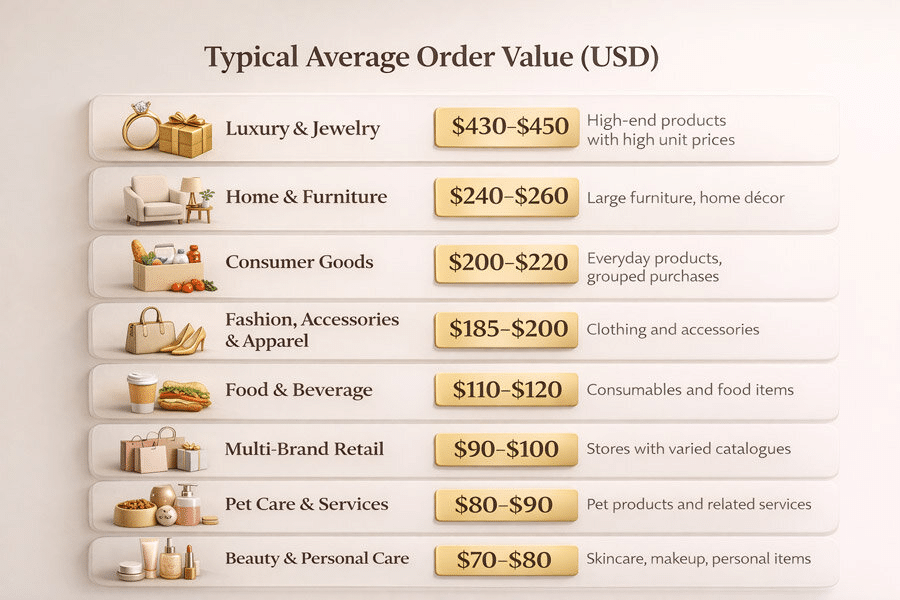
Average order values vary widely by industry. For example, the average order value of a store selling apparel is quite different from that of a store selling furniture or electronics. Therefore, rather than trying to find a single average order value (i.e., the “average” AOV across all merchants), it is more effective for merchants to use their respective industries as benchmarks.
Below are typical average order value ranges across major ecommerce sectors, based on recent industry statistics (such as Oberlo ecommerce benchmarks).
| Industry | Typical AOV Range (USD) | Product Type |
| Luxury & Jewelry | $430–$450 | High-end products with high unit prices |
| Home & Furniture | $240–$260 | Large furniture, home décor |
| Consumer Goods | $200–$220 | Everyday products, grouped purchases |
| Fashion, Accessories & Apparel | $185–$200 | Clothing and accessories |
| Food & Beverage | $110–$120 | Consumables and food items |
| Multi-Brand Retail | $90–$100 | Stores with varied catalogues |
| Pet Care & Services | $80–$90 | Pet products and related services |
| Beauty & Personal Care | $70–$80 | Skincare, makeup, personal items |
According to recent ecommerce industry data, the luxury and jewelry sector shows the highest average order values, reflecting the premium nature of its products, followed by home and furniture and consumer goods. Categories such as beauty and personal care typically have lower AOV due to lower product prices.
Industry Summaries
- Luxury & Jewelry: AOV in this sector is the highest among online retail categories, driven by expensive products.
- Home & Furniture: Buying patterns in this category often involve larger, higher-priced items, resulting in mid-to-high order values.
- Consumer Goods: Products such as packaged goods and bulk purchases tend to fall in the mid-range AOV.
- Fashion & Apparel: Mid-priced clothing and accessories lead to moderate AOV figures, often increased by multi-item purchases.
- Food & Beverage: Consumables typically have lower order values, but bundling and repeat purchases can boost AOV.
- Multi-Brand Retail: A mix of products with varying prices results in moderate average order sizes.
- Pet Care & Services and Beauty & Personal Care: These categories typically have lower average order values due to smaller or lower-priced products.
What Is a Good Average Order Value (By Industry & Platform)?
There is no universal answer to what a good average order value is. AOV depends on several factors:
- Industry (fashion vs furniture vs beauty)
- Product price point (low-ticket vs high-ticket)
- Target audience (budget vs premium)
- Acquisition channels (discount-driven vs brand-driven)
The best way to monitor how well you’re performing in your industry is to compare your AOV against industry benchmarks. For example, an AOV of $60 may be considered a fantastic result if you are in the skincare product space. However, it would likely be viewed as poor performance in the furniture industry.
Additionally, when examining platforms such as Shopify, WooCommerce, Amazon, and BigCommerce, you will likely see different AOV patterns based on the types of businesses using them. Therefore, when comparing your AOV to other businesses in your industry group, you should consider how products and services are classified rather than simply the platforms they use to acquire customers.
As a general rule, a good average order value will either be consistent with your competitors’ average order values or increase at a consistent rate without lowering your conversion rate or margins.
Key Factors That Influence Average Order Value in Ecommerce
AOV isn’t random. It’s shaped by how products are priced, presented, and promoted.
- Product price points & mix – The balance between low- and high-priced items matters.
- Number of items per order – Multi-item purchases raise AOV.
- Discounts & promotions – Volume discounts and thresholds influence order size.
- Product bundling & merchandising – Kits, sets, and gift boxes increase perceived value.
- Upsell & cross-sell strategy – Relevant add-ons drive larger baskets.
- Customer segment & acquisition channel – Returning customers often have higher AOV.
- Store UX & checkout experience – Friction reduces multi-item purchases.
How to Increase Average Order Value in Ecommerce (Practical Strategies)
To boost ecommerce sales, retailers need to ensure that customers find it easy and logical to purchase added-value products. Here are some successful, proven tactics that have been used by many ecommerce and Shopify merchants to consistently increase their average order value without adversely impacting conversion rates.
Use Product Bundles & “Build Your Own” Boxes
Product bundling is one of the most effective strategies to increase AOV on Shopify, especially when complementary items are grouped together as fixed kits or mix-and-match offers.
Product bundling means selling complementary products together as a set, kit, or customizable box. This increases perceived value while naturally increasing the number of items per order.
How to do it in an ecommerce / Shopify store:
- Create fixed bundles (e.g., “Complete Skincare Routine” instead of one serum).
- Offer mix-and-match or build-your-own bundles where customers choose items.
- Add Frequently Bought Together bundles on product pages.
- Show bundle savings clearly (e.g., “Save 15% compared to buying separately”)
- Highlight bundles on product pages, collection pages, and the cart.
- Works best for: beauty & skincare, food & beverage, apparel, wellness, gifts.
Offer Volume Discounts & Tiered Pricing
Volume discounts reward customers for buying more units of the same product, making higher cart values feel like a smart deal.
How to do it in an ecommerce / Shopify store:
- Set tiers like Buy 2, Save 10% / Buy 3, Save 15%.
- Display savings directly on product pages, not just at checkout.
- Use visual badges like “Best Value” on higher tiers.
- Combine volume discounts with subscriptions for extra incentive.
- Apply discounts automatically (no coupon codes needed).
Works best for: consumables, supplements, beauty products, and office supplies.
Set Smart Free Shipping Thresholds
Free shipping is one of the strongest AOV levers when used strategically. The key is setting the threshold slightly above your current average order value.
How to do it in an ecommerce / Shopify store:
- Calculate your current average order value e-commerce metric.
- Set free shipping $10–30.
- Add a progress bar in the cart (“$12 away from free shipping”).
- Mention free shipping thresholds on product pages and headers.
- Test different thresholds to find the sweet spot.
Works best for: most ecommerce stores, especially fashion and DTC brands.
Add Relevant Upsells & Cross-Sells
Upsells and cross-sells encourage customers to add complementary or upgraded items right before checkout.
How to do it in an ecommerce / Shopify store:
- Add “You may also like” or “Complete the set” sections.
- Offer cart upsells (e.g., accessories, add-ons, refills).
- Keep recommendations highly relevant to the main product.
- Use one-click add-to-cart for upsells.
- Avoid overwhelming users, 2-4 suggestions max.
Works best for: electronics, apparel, beauty, and home goods.
Create Good–Better–Best Packages
Pricing tiers anchor customers toward higher-value options by making mid or premium choices feel more reasonable.
How to do it in an ecommerce / Shopify store:
- Offer three options: Basic / Standard / Premium.
- Highlight the middle or top tier as “Most Popular”.
- Clearly show the extra value of higher tiers.
- Bundle services, warranties, or bonuses in premium tiers.
- Use comparison tables to simplify decisions.
Works best for: software, electronics, fitness programs, and luxury goods.
Promote Subscriptions & Replenishment
Subscriptions increase both AOV and lifetime value by locking in recurring purchases.
How to do it in an ecommerce / Shopify store:
- Offer “Subscribe & Save” options on product pages.
- Provide small incentives (5–15% off or free shipping).
- Allow easy subscription management (skip, pause, cancel).
- Highlight convenience, not just savings.
- Suggest subscriptions after first-time purchases.
Works best for: consumables, skincare, supplements, and pet products.
Use Limited-Time Offers
Urgency motivates customers to choose higher-value bundles instead of single items.
How to do it in an ecommerce / Shopify store:
- Create limited-time bundle deals (“This week only”).
- Use countdown timers on bundle pages.
- Promote seasonal or holiday kits.
- Emphasize scarcity (“Limited stock available”).
- Feature bundles in email and SMS campaigns.
Works best for: beauty, fashion, gifting, seasonal products.
Improve On-Site Search & Navigation
When customers easily find more relevant products, they naturally add more to their cart.
How to do it in an ecommerce / Shopify store:
- Optimize search with autocomplete and synonyms.
- Highlight popular and high-margin products in search results.
- Add filters for price, bundles, and bestsellers.
- Create curated collections (e.g., “Complete Sets”)
- Use internal linking between related products.
Works best for: large catalogs, marketplaces, and multi-category stores.
Personalize for High-Value Customers
Personalization helps repeat customers increase order size without feeling “sold to.”
How to do it in an ecommerce / Shopify store:
- Recommend products based on browsing or purchase history.
- Show “Recommended for you” sections.
- Offer exclusive bundles to VIP or repeat customers.
- Use email personalization for upsell campaigns.
- Adjust offers based on average spend per customer.
Works best for: fashion, beauty, lifestyle, subscription-based brands.
How to Track & Analyse Average Order Value Over Time
Track AOV:
- Overall
- By channel (paid, email, organic)
- By customer type (new vs returning)
Use ecommerce dashboards such as Shopify Analytics, GA4, or simple spreadsheets to apply the average order value formula. Compare trends over time, not just single snapshots, and evaluate how each average order value calculation changes after new strategies.
Common Mistakes When Optimising for AOV
Improving AOV can be an effective strategy for growing your eCommerce business. Many eCommerce companies hurt their performance by optimising the AOV incorrectly. Here are the major mistakes to avoid when looking to increase your AOV, with a focus on Shopify and DTC eCommerce stores:
- Chasing AOV over conversion rate
Too many upsells or pop-ups can hurt conversions. Higher AOV means little if fewer people buy. - Relying only on discounts
Discounts may lift AOV short term, but damage margins long term. - Ignoring customer experience
Confusing bundles or pricing reduces trust and increases cart abandonment. - Not segmenting customers
New vs. repeat buyers respond to different offers and treat them differently. - Forgetting profitability
Higher AOV doesn’t matter if shipping, discounts, and costs erase profit. - Using the wrong benchmarks
A “good” AOV varies by industry; compare wisely.
In eCommerce, AOV is just as essential to driving growth as traffic and conversion rate. By understanding what AOV is, mastering how to calculate it, benchmarking against other industries, and testing proven techniques, you can efficiently grow your eCommerce revenue! First, calculate your current AOV and compare it with your industry. Then, discuss one or two ways to increase your AOV over the next month!
Conclusion: Make AOV a Core Ecommerce Metric in 2026
In ecommerce, average order value is just as important as traffic and conversion rate. By understanding the average order value, mastering the formula, benchmarking across industries, and applying proven strategies, you can efficiently grow revenue. Start by calculating your current AOV, comparing it to your industry, and testing one or two tactics over the next month.
FAQ
What is the average order value in ecommerce?
Average order value is the average amount customers spend per order on an online store.
How is the average order value calculated?
AOV is calculated as total revenue divided by the number of orders.
Why is the average order value important for online stores?
It improves profitability, marketing efficiency, and revenue growth.
What is a good average order value?
It depends on your industry and business model. Use industry benchmarks.
How often should I measure AOV?
Monthly, quarterly, and during major campaigns.
How can I quickly increase the average order value in ecommerce?
Use bundles, volume discounts, and free shipping thresholds.
Related Articles